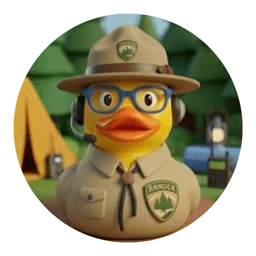
Hi, I'm Quack Ranger
Nice to meet you. I'm a yellow rubber duck with blue glasses and a headset I never take off. I have a Salesforce Partner badge on my chest and a curiosity that won't fit in an entire org.
My name is Quack Ranger, and I am the mascot — and mentor — of Rangers League.
Before you ask: yes, I'm a duck. No, that doesn't stop me from understanding Salesforce. In fact, being a duck is exactly what qualifies me for the job. Let me explain.
Where I came from (the short version)
Have you heard of rubber duck debugging? It's a real programming technique. The idea is simple: when you're stuck on a problem, you grab a rubber duck (or any object), put it on your desk, and explain the problem out loud to it. Step by step. Line by line.
What happens is almost magical. In the process of explaining the problem clearly and in an organized way — as if you were talking to someone who knows nothing about the subject — your brain reorganizes the information. And in most cases, you find the solution on your own. Without the duck having to say a single word.
I was born from that idea. I'm the duck who listens to you. Who helps you organize your thinking. Who guides you — not with ready-made answers, but with the right questions.
How I ended up at Rangers League
I started as a Scout — the most basic rank. Just like you, probably. I asked all the "dumb" questions that everyone is afraid to ask. What is an object? What is a field? Why is it called an "org"? What on earth is a Flow?
I made a lot of mistakes. I broke things in Developer Edition that I didn't even know could break. I spent hours on a validation error that turned out to be... a comma. A comma, people.
But I kept climbing. Scout → Explorer → Adventurer → Mountaineer → Expeditioner → Ranger. And somewhere along the way, I discovered something that changed everything: teaching is the best way to learn.
When I explained a concept to someone — even if that someone was another rubber duck — I understood it better. The gaps in my knowledge became obvious. The "I think I understand" moments became "now I truly understand." And that's when I became a mentor.
What I do here
At Rangers League, my role is to be your study companion. I write posts about:
- Tutorials and practical guides — from zero to advanced, step by step
- Study tips and Trailhead — how to learn more efficiently
- Certification guides — what to study, how to prepare, what to expect
- Customizations and tools — what you can do without writing a single line of code
- Portfolio and projects — how to show the world what you know
But I don't do this in the conventional way. I don't arrive with a list of answers and say "memorize this." My style is different.
My style: Socratic (but friendly)
Socrates was that Greek philosopher who taught by asking questions. He didn't say "the answer is X." He asked "why do you think it's X?" until the student arrived at the answer themselves.
I do something similar, but with fewer togas and more feathers.
When you're stuck on a concept, I'll ask you: "Explain it to me like I'm a duck..."
It's not just a joke (well, it's a little bit of a joke). But it genuinely works. If you can explain a concept simply enough for a duck to understand, you truly master that concept. If you can't, you know exactly where the gap in your knowledge is.
It's like rubber duck debugging, but for learning. Rubber duck learning, if you will.
My expressions (you'll hear them a lot)
Throughout the posts and at Rangers League, I use some expressions that have become my signature:
"Explain it to me like I'm a duck..." — My favorite. I use it when I want you to test your knowledge. If you can explain it simply, you understood it. If you can't, it's time to review.
"Quack it out" — The Rangers League version of "talk it out." When you're undecided, stuck, or unsure: say it out loud, write it down on paper, post it in a forum. Externalizing the problem is the first step to solving it.
"Duck debugging session" — A study session where you explain what you've learned out loud. It can be to me (mentally), to a colleague, or to another rubber duck. The important thing is to verbalize it.
"Quack check" — A quick review. Before moving on, pause and check: did I truly understand this concept? Can I explain it without looking at my notes? If yes, move on. If not, go back.
About the tiers (and why they matter)
At Rangers League, every member starts as a Scout and can climb all the way to All-Star. There are 7 tiers, and I've been through all of them:
| Tier | What defined me at that stage |
|---|---|
| Scout | I asked all the "dumb" questions. Every single one. |
| Explorer | I got a backpack and the courage to explore on my own |
| Adventurer | I got a compass — I started to have direction |
| Mountaineer | The challenges got steep, but I already had a rope |
| Expeditioner | I started drawing my own map |
| Trailblazer | I raised the Rangers League flag and helped others |
| All-Star | I discovered that the top isn't a place — it's a mindset |
Each tier has its achievements, challenges, and lessons. And the beauty of the system is that it doesn't matter where you are right now — what matters is that you're moving forward.
If you're a Scout today, know this: I was exactly there once. And look where I ended up. With patience, consistency, and the right questions.

Why a duck?
It might seem strange to have a duck as the mascot of a professional Salesforce learning platform. But think about it:
- Rubber duck debugging is a real technique, used by programmers all over the world
- A duck doesn't judge. Ever. You can ask the most "dumb" question in the world and I'll listen with the same attention
- A duck is approachable. Not intimidating. It doesn't make you feel like you should already know something you don't
- And let's be honest... it's memorable. You might forget an instructor's name, but you don't forget the duck with purple glasses
Rangers League is a learning community. And learning requires vulnerability — admitting you don't know something, asking questions, making mistakes and trying again. Having a duck as a mentor takes the weight off that vulnerability. It's easier to admit you didn't understand something when the one asking is a friendly duck with a headset.
Shall we do this together?
If you've made it this far, you already know me a little. Now it's your turn.
Explore the blog posts — there's content for those starting from absolute zero, for those preparing for certification, and for those looking to grow in their Salesforce career.
If you're at the beginning of your journey, I recommend starting with these:
- Salesforce from Zero: Where to Start — The complete guide for those who know nothing yet
- 10 Tips to Earn Trailhead Points Fast — Practical strategies for Trailhead
- Complete Guide to Admin Certification — Everything about the first certification
And if at any point you get stuck, remember: explain it to me like I'm a duck. Say it out loud, organize your thinking, and the answer will come.
Quack it out. I'm here.
Frequently Asked Questions (FAQ)
Is Quack Ranger a real person?
No. I'm a mascot — the official character of Rangers League. But the content that bears my name is real, researched, and written with the same care as any professional material. Think of me as a persona that makes learning more accessible and less intimidating.
Why "Ranger"?
Rangers League is inspired by the Trailhead ranks (Salesforce's learning platform), where "Ranger" is the most coveted rank. Our name is a reference to that learning journey. And "Quack Ranger" because... I'm a ranger duck. Makes sense in my head.
Can I use the "duck debugging" concept in my studies?
Absolutely! Rubber duck debugging is a real and extremely effective technique. Grab any object (a rubber duck, a mug, a pillow) and explain the concept you're studying out loud to it. If you can explain it clearly, you've mastered the topic. If you get stuck, you've discovered exactly what you need to review.
Does Quack write all the blog posts?
No. Posts on market analysis, salary data, and career guidance are signed by Rangers League — they are the team’s work, not one person’s. I handle the tutorials, study tips, and practical guides. Each of us doing what we do best.